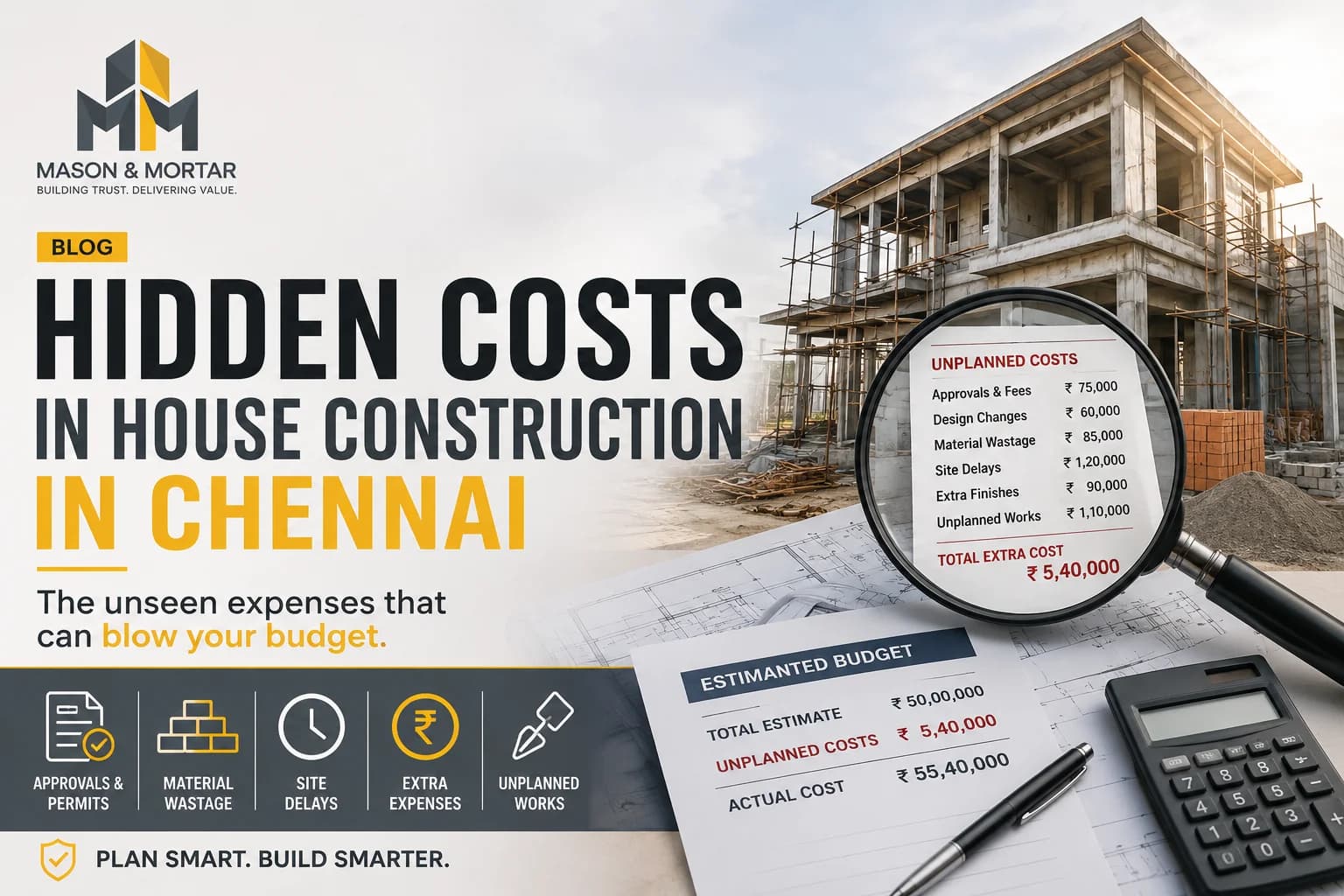
Three builders. The same architectural drawing. The same 2,000 sq.ft. house in Chennai. Yet the quotations are ₹58 lakhs, ₹63 lakhs and ₹68 lakhs. Which one would you choose? Most homeowners naturally choose the lowest quotation because it appears to offer the best value.
Six months later, many discover that the ₹58 lakh house has become a ₹69 lakh project. The surprising part is that the contractor may not have increased the price unfairly. In many cases, the quotations were never the same to begin with.
“The biggest mistake isn't choosing the wrong contractor. It's comparing quotations that are not actually comparable.”
Building a home is one of the largest financial investments a family makes. Yet many homeowners compare construction quotations only by the final amount. They rarely compare what is included, what is excluded, which materials are specified or how the quantities have been calculated.
This article is not intended to create fear or suspicion about contractors. Instead, it will help you understand how construction quotations are prepared, why they differ, and how you can compare them fairly before making a decision.
What You'll Learn
Compare Construction Quotations Like an Engineer
By the end of this guide, you'll understand why quotations for the same house can differ by ₹10 lakhs or more, which items are commonly excluded, how material specifications affect pricing, and why a BOQ-based quotation offers greater transparency.
Before comparing quotations, it's also important to understand the difference between Project Management Consultancy (PMC) and Turnkey Construction.
Read our PMC vs Turnkey Guide→Not Every Construction Quotation Means the Same Thing
Imagine buying two cars at exactly the same price. One includes six airbags, alloy wheels, premium interiors and advanced safety systems. The other includes only the basic features. Even though both carry the same price tag, they are not the same product.
Construction quotations work in a very similar way. Two builders may quote for the same floor plan, but the scope of work, material specifications, engineering assumptions and quantities can be completely different.
Before comparing prices, every homeowner should compare four important factors.
- Scope of work included in the quotation.
- Items excluded from the quotation.
- Material brands and technical specifications.
- Engineering quantities used to calculate the estimate.
“The cheapest quotation doesn't always build the cheapest house. Quite often, it builds a different house.”
What Is Usually Not Included in a Construction Quotation?
One of the biggest reasons homeowners experience budget overruns is that they assume everything required to complete the house is included in the quoted price. In reality, many contractors prepare quotations only for the main building, while several external works are treated as separate items.
| Usually Included | Usually Quoted Separately |
|---|---|
| Main Building Structure | Underground Water Sump |
| Brickwork | Septic Tank |
| Roof Slab | Overhead Water Tank |
| Internal Plastering | Compound Wall |
| Internal Flooring | Main Entrance Gate |
| Basic Painting | Terrace Weatherproof Course |
| Basic Electrical | Terrace Tiling |
| Basic Plumbing | External Drainage & Landscaping |
🏗 Mason & Mortar Engineering Insight
Per Square Foot Doesn't Mean Everything Is Included
Most per-square-foot quotations are calculated based on the built-up area measured from the outer face of the building walls. External works such as the sump, septic tank, compound wall, gate, terrace weatherproof course and landscaping are often separate unless specifically mentioned in the scope of work.
1. Underground Water Sump
A water sump is one of the first structures constructed on most residential sites in Chennai. It stores the municipal or tanker water supply before it is pumped to the overhead tank. Although it is essential for daily living, many homeowners are surprised to learn that it is often excluded from standard construction quotations.
The size of the sump depends on your family's water requirement, plot size and local water availability. Excavation, RCC work, waterproofing, plumbing connections and covers all contribute to its cost.
⚠ Homeowner Mistake
Don't Assume the Sump Is Included
Always ask whether the water sump is part of the quotation or billed separately. Never assume it is included simply because the quotation mentions 'complete house construction'.
2. Septic Tank
If your plot is not connected to an underground sewer network, a septic tank becomes an essential part of the project. Since every site has different requirements, many contractors quote it separately instead of including it in the per-square-foot rate.
Its size, depth, soil condition and local authority requirements can significantly influence the overall cost.
3. Overhead Water Tank (OHT)
The overhead water tank supplies water throughout the house. Whether it is constructed in RCC or installed as a prefabricated tank, it is frequently treated as a separate scope in construction quotations.
Apart from the tank itself, supporting slab work, plumbing connections and accessories should also be clarified before signing the agreement.
4. Compound Wall and Main Gate
A beautiful house without proper site security is incomplete. Yet compound walls and entrance gates are among the most commonly excluded items in residential construction quotations.
The final cost depends on the plot perimeter, wall height, foundation depth, gate width, material selection and architectural design. Homeowners often assume these works are included, only to discover later that they require a separate budget.
“A quotation may include the house, but not necessarily everything required to make it a complete home.”
5. Terrace Weatherproof Course
Many homeowners think construction ends once the roof slab is completed. In reality, the terrace requires additional protection to improve durability and reduce water leakage.
- Weatherproof course
- Protective screed
- Drainage slope correction
- Waterproofing treatment
- Surface finishing
If these items are excluded from the quotation, they become additional expenses before the house can be considered fully complete.
6. Terrace Tiling
Terrace tiles improve walkability, reduce heat absorption and protect the waterproofing layer. Since many homeowners decide on the tile type later, this work is frequently excluded from the basic construction package.
🏗 Mason & Mortar Engineering Insight
The Roof Slab Is Not the Finished Terrace
A completed roof slab is only the structural component. Weatherproofing, slope correction and terrace finishing are separate construction activities that should be clearly identified in the quotation.
7. External Development Works
After the house is completed, several external works are still required to make the property functional and visually complete. These items are commonly excluded unless specifically mentioned.
- Paving blocks
- Driveway
- Landscaping
- Garden edging
- External drainage
- Rainwater harvesting connections
- Outdoor lighting
- Utility area finishing
These works may appear minor individually, but together they can add a significant amount to the final project budget.
Planning your budget? Read our detailed Chennai Construction Cost Guide to understand how different construction components affect the overall project cost.
House Construction Cost in Chennai (2026)→8. Basement Height Beyond the Standard Design
Most residential quotations are prepared assuming a standard plinth or basement height of around 3 feet from the finished ground level. During construction, homeowners often decide to increase this height for a grander elevation, better flood protection or to suit the site's natural levels.
What appears to be a small change actually increases excavation, earth filling, concrete, brick masonry, plastering, backfilling and labour. It also affects the quantity of steps leading into the house.
🏗 Mason & Mortar Engineering Insight
One Foot Doesn't Mean One Foot of Cost
Increasing the basement height doesn't simply add one foot of brickwork. It affects multiple construction activities, each contributing to the overall project cost.
9. Higher Floor-to-Floor Height
Many quotations assume a floor height of approximately 10 feet. During the design stage or even after construction begins, homeowners often request 11-foot or 12-foot ceilings to create a more spacious and luxurious interior.
A higher ceiling increases much more than the wall height. It also increases plastering area, paint quantity, scaffolding, electrical conduit lengths, plumbing pipe lengths and overall labour.
“Luxury is rarely created by one expensive material. It is usually created by hundreds of small upgrades throughout the project.”
10. Flooring Upgrades
Most quotations are prepared using a predefined flooring specification. Homeowners frequently upgrade from standard vitrified tiles to granite, premium vitrified tiles, imported tiles or natural stone after seeing showroom displays.
The additional cost is not limited to the material. Granite and premium flooring require higher installation labour, specialised cutting equipment, increased polishing and sometimes additional structural consideration due to weight.
11. Premium Material Selection
Construction quotations are prepared based on a specific material specification. If the homeowner later chooses premium products beyond the agreed specification, the project budget naturally changes.
| Construction Component | Typical Mason & Mortar Specification |
|---|---|
| Cement | Ramco / UltraTech / Coromandel |
| Steel | Tata Steel / JSW Steel |
| Plumbing | Finolex / Ashirvad |
| Electrical Wires | Orbit / Finolex / Polycab / Havells |
| Switches | GM / Legrand / Anchor |
| Waterproofing | Sika / Dr. Fixit / Fosroc (as specified) |
A quotation prepared using established brands will naturally differ from one based on economy-grade alternatives. Before comparing prices, always compare the material specification sheet.
⚠ Homeowner Tip
Don't Compare Price Alone
If one quotation clearly specifies the brands and another simply states 'standard materials', the two quotations are not directly comparable.
12. Design Changes During Construction
One of the most common reasons for budget overruns is changing the design after construction has started. Even small modifications can affect multiple trades and require additional materials and labour.
- Increasing window sizes
- Adding a balcony
- Changing staircase layout
- Adding an extra bathroom
- Moving internal walls
- Changing the front elevation
- Extending the sit-out
- Adding a utility room
Finalising the design before construction begins is one of the most effective ways to control both project cost and construction time.
Why Two Quotations Can Differ by ₹10 Lakhs (or More)
One of the biggest misconceptions among homeowners is that two contractors quoting for the same house should arrive at almost the same price. In reality, construction quotations can differ by several lakhs because they are often prepared using completely different assumptions.
A lower quotation does not automatically mean a contractor is offering a better deal. Likewise, a higher quotation does not necessarily mean the contractor is overcharging. Before comparing prices, you must understand what is actually being compared.
“Don't compare the price. Compare the scope, the specifications and the engineering behind the quotation.”
Reason 1: Difference in Scope of Work
The first and most common reason for a price difference is the scope of work. One contractor may include only the main building, while another includes several external works that are essential for completing the project.
| Item | Quotation A | Quotation B |
|---|---|---|
| Main Building | ✓ | ✓ |
| Underground Water Sump | ✗ | ✓ |
| Septic Tank | ✗ | ✓ |
| Overhead Water Tank | ✗ | ✓ |
| Compound Wall | ✗ | ✓ |
| Main Gate | ✗ | ✓ |
| Terrace Weatherproof Course | ✗ | ✓ |
| Terrace Tiling | ✗ | ✓ |
At first glance, Quotation A appears significantly cheaper. However, once all of these excluded works are added during construction, the total project cost may become very similar—or even exceed Quotation B.
🏗 Mason & Mortar Engineering Insight
A Lower Quote May Simply Cover Less Work
Always request a detailed scope of work before comparing quotations. The final amount alone does not tell the complete story.
Reason 2: Material Specifications
Even if two quotations include exactly the same scope of work, the materials specified can be entirely different. This is one of the biggest reasons why construction prices vary.
Some quotations clearly specify the brands and product standards to be used, while others simply mention 'standard quality materials'. Without detailed specifications, it becomes impossible for a homeowner to compare two quotations fairly.
| Construction Material | Typical Mason & Mortar Specification |
|---|---|
| Cement | Ramco / UltraTech / Coromandel |
| Steel | Tata Steel / JSW Steel |
| Plumbing Pipes | Finolex / Ashirvad |
| Electrical Wires | Orbit / Finolex / Polycab / Havells |
| Switches | GM / Legrand / Anchor |
| Waterproofing | Sika / Dr. Fixit / Fosroc (as specified) |
These specifications are shared as examples of the quality standards typically adopted in Mason & Mortar projects. Equivalent approved brands may also be used depending on client preference, availability and project requirements.
⚠ Homeowner Tip
Ask for the Material Specification Sheet
Never compare two quotations unless both clearly mention the brands and specifications of the major construction materials.
Reason 3: Engineering Quantities
This is perhaps the least understood difference between construction quotations. Two contractors may specify the same brands, yet the quantity of materials used can vary significantly based on engineering decisions.
Examples include the quantity of reinforcement steel, concrete consumption, plaster thickness, waterproofing coverage, curing practices and other construction details that are rarely visible after the house is completed.
- Steel reinforcement quantity
- Concrete grade and cement consumption
- Plaster thickness
- Concrete cover for reinforcement
- Waterproofing application
- Brickwork quantities
- Curing duration
- Structural detailing as per design
A house may look beautiful on the day of handover, but its long-term durability depends on many engineering decisions that remain hidden inside the structure.
“Two houses can look identical from the outside, yet be fundamentally different in the quality hidden inside their concrete, steel and walls.”
Want to understand why a BOQ provides better cost transparency than a simple per-square-foot quotation?
Read our PMC vs Turnkey Guide→Questions Every Homeowner Should Ask Before Signing a Construction Agreement
Before selecting a contractor, don't stop at asking for the final quotation amount. A few simple questions can help you understand exactly what you're paying for and prevent unexpected expenses during construction.
- Is the underground water sump included?
- Is the septic tank included?
- Is the overhead water tank included?
- Does the quotation include the compound wall and main gate?
- Is terrace weatherproofing included?
- Are terrace tiles included?
- What basement height has been considered?
- What floor-to-floor height has been considered?
- Which cement, steel, plumbing and electrical brands are included?
- Are interior works part of this quotation?
- How will design changes be priced during construction?
- Can you provide a detailed BOQ instead of only a per-square-foot quotation?
🏡 Homeowner Checklist
Compare Before You Commit
If a contractor cannot clearly explain what is included, what is excluded and which material specifications have been considered, you should think twice before making your decision.
How Mason & Mortar Keeps Construction Transparent
At Mason & Mortar, we believe that transparency is one of the most important foundations of a successful construction project. Instead of relying only on a per-square-foot quotation, we prepare a detailed Bill of Quantities (BOQ) that clearly defines the scope of work, material specifications and measurable quantities wherever applicable.
This allows homeowners to understand exactly what is included before construction begins. If the client later chooses to upgrade materials, increase floor heights or make design changes, the additional cost is discussed and approved before execution. This helps prevent misunderstandings and gives homeowners complete visibility into how their budget is being spent.
We are also proud to say that Mason & Mortar has never intentionally secured a project by offering an unrealistically low quotation and later demanding additional payments simply to complete the originally agreed scope. Our objective is not to be the cheapest contractor. Our objective is to deliver quality construction with complete transparency, engineering expertise and professional project management.
“The best construction projects are not built on the lowest quotation. They are built on clear expectations, detailed planning and complete transparency.”
If you're planning to build your first home, don't miss our guide on choosing the right construction partner.
How to Choose a Construction Contractor→Final Thoughts
Building a home is one of the largest financial commitments most families will ever make. Choosing the lowest quotation without understanding what it includes can lead to avoidable stress, budget overruns and unnecessary disputes during construction.
Before comparing prices, compare the scope of work, material specifications, engineering standards and measurable quantities. A transparent quotation allows you to make informed decisions, plan your finances confidently and avoid surprises as your project progresses.
Remember, the cheapest quotation is not always the least expensive home. The quotation that clearly defines what is included, what is excluded and how the project will be executed is often the one that delivers the greatest long-term value.
Need Expert Guidance?
Planning to Build Your Dream Home in Chennai?
If you're comparing construction quotations or planning your project, Mason & Mortar can help you review your drawings, understand the scope, prepare a transparent BOQ and guide you before construction begins. A well-planned project starts with the right information.
Frequently Asked Questions
Why do construction quotations differ for the same house?
Construction quotations differ because of variations in the scope of work, material specifications, engineering quantities, project assumptions and items excluded from the quotation.
Does a per-square-foot quotation include everything required to complete a house?
Not always. Many quotations exclude items such as the water sump, septic tank, compound wall, gate, terrace weatherproofing and interior works unless they are specifically mentioned.
What is the advantage of a BOQ-based quotation?
A Bill of Quantities (BOQ) clearly defines the scope of work, quantities and specifications, making it easier for homeowners to understand costs and compare quotations fairly.
Will changing flooring from tiles to granite increase construction cost?
Yes. Premium flooring materials usually increase both the material cost and installation labour, making the overall project more expensive.
Why should I compare material specifications before choosing a contractor?
Material specifications directly influence the quality, durability and cost of a house. Comparing specifications helps ensure that you are evaluating quotations on an equal basis rather than comparing only the final price.
Does Mason & Mortar provide BOQ-based construction planning?
Yes. Mason & Mortar follows a transparent BOQ-based approach that clearly explains the project scope, specifications and measurable quantities before construction begins.