A family purchases a brand new villa in Chennai. Within a year of moving in, the bathroom ceiling is damp. The ground floor walls have moisture patches rising from the base. The freshly painted surfaces are peeling and stained. The builder is unreachable or unwilling to take responsibility.
“The correct waterproofing treatment during construction would have cost less than ₹50,000. The repairs cost ₹4.5 lakhs.”
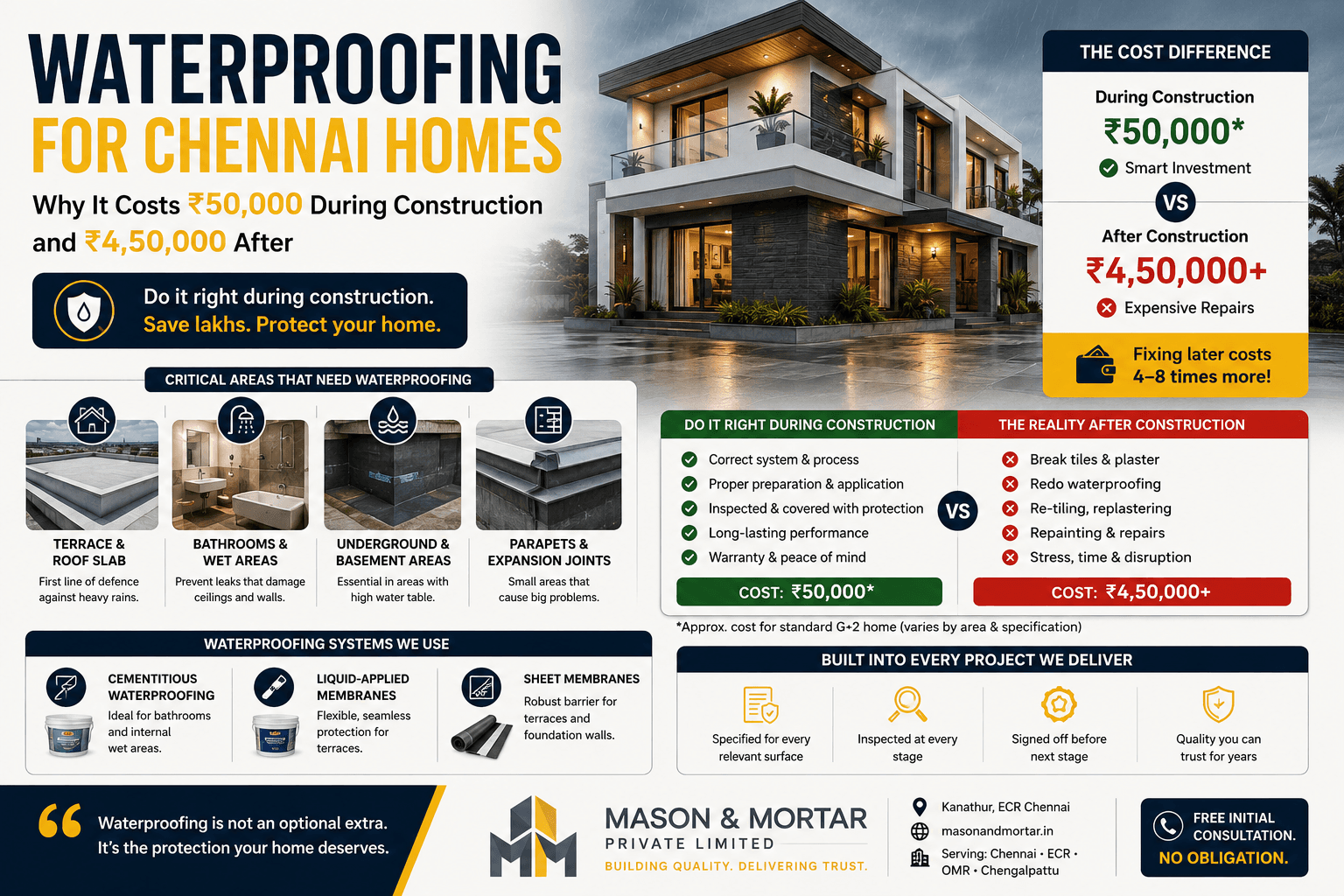
This is not a rare story. It happens across Chennai, ECR, OMR, and Chengalpattu every year — in new constructions, completed and handed over, that looked perfectly fine at possession. We recently helped a friend in exactly this situation. His villa was less than a year old. The waterproofing repairs cost him over ₹3 lakhs. The repainting that followed cost another ₹1.5 lakhs. Total damage: approximately ₹4.5 lakhs, significant disruption, and a home that had already started deteriorating. The correct waterproofing treatment during construction would have cost less than ₹50,000.
Mason & Mortar supervises waterproofing at every stage on all PMC and turnkey projects.
See Our PMC Services→Why Waterproofing Fails in Chennai
Chennai's climate is not forgiving on buildings. You have a long monsoon season with heavy rainfall, a coastal environment with high humidity throughout the year, and in many areas — particularly along ECR and in low-lying parts of OMR and Chengalpattu — a high water table. These conditions mean that water finds every weakness. A hairline crack in a terrace, an inadequately sealed bathroom floor, a parapet joint that was not treated properly — any of these becomes a water entry point over time.
The problem is compounded by timing. Waterproofing is applied during construction, before finishes go on top. By the time the home is handed over and the family moves in, it is covered under tiles, plaster, and paint. If it was done poorly, you will not know for six months to a year — until the first monsoon does its work. By then, the repair is not just about waterproofing. It is about removing tiles, hacking plaster, redoing the treatment, replastering, retiling, and repainting. The cost multiplies four to eight times compared to doing it correctly during construction.
The Areas That Matter Most in a Chennai Home
Not every surface carries the same waterproofing risk. These are the areas where a failure will cost you the most.
Highest Risk Area
Terrace and Roof Slab
The most critical surface in any Chennai home. Every drop of rain lands here first. The terrace treatment must cover the entire slab, turn up at all parapets to a sufficient height, and be properly protected before the finishing screed goes over it. A missed spot or a parapet upturn done too shallow will allow water to track horizontally under the screed and appear as a damp patch on the ceiling below — sometimes several feet away from the actual entry point.
First Failure Usually Visible Here
Bathrooms and Wet Areas
Bathroom waterproofing is frequently the first failure visible inside a home. The floor-to-wall junction, the area around drainage outlets, and the base of walls in wet zones are all high-risk points. When a bathroom on the first floor leaks into the ceiling of the room below, the repair involves opening up the floor above — not just patching the ceiling below.
Critical in ECR Low-Lying Areas
Underground and Foundation Areas
For plots with a high water table — common in many parts of ECR, particularly in low-lying areas closer to the coast — groundwater rising through the foundation walls and floor is a serious and expensive problem. A villa in an area with seasonal water table rise needs both external waterproofing of the foundation walls and internal moisture protection. When this is skipped during construction, the remediation after the fact is among the most invasive and costly repairs a homeowner can face.
Small Area — High Consequence
Parapet Walls and Expansion Joints
The top of a parapet wall and any expansion or construction joint in the terrace are common entry points that are easy to overlook during construction and difficult to access and treat correctly once the building is finished.
The Waterproofing Systems We Use — and Why It Varies by Location
There is no single waterproofing system that is correct for every surface in every location. The right treatment depends on the surface, the exposure, and the site conditions.
| System | Best Used For | Why |
|---|---|---|
| Cementitious Waterproofing | Bathrooms and internal wet areas | Bonds well with substrate, tolerates minor movement, straightforward to apply correctly |
| Liquid-Applied Membrane | Terraces and areas with thermal movement | Flexible — accommodates slab expansion and contraction under Chennai sun |
| Sheet Membrane (APP/SBS) | Terraces on larger structures, external foundation walls | Robust, long service life, reliable barrier for high-exposure surfaces |
“A bathroom does not need the same treatment as a terrace. The specification is not a one-size-fits-all decision.”
What Correct Waterproofing Looks Like During Construction
Good waterproofing is not just about the material — it is about the process and the timing. Surface preparation matters more than most homeowners realise. A membrane applied over a dusty, oily, or incompletely cured surface will not bond correctly regardless of the quality of the product. This is one of the first things we check on site.
- Surface preparation verified before any membrane is applied
- Thickness and continuity checked before the next trade moves in
- Upturn heights at parapets and door thresholds confirmed against specification
- No waterproofing stage covered up until inspected and approved
- Stage sign-off documented before plastering or tiling begins
“Checking waterproofing before tiles or screed go on top costs nothing. Checking it after costs a great deal.”
What to Ask When Building Your Home
- Which waterproofing system is specified for the terrace, bathrooms and foundation?
- What is the thickness and number of coats specified?
- Who inspects the waterproofing before it is covered up?
- Is there a warranty on the waterproofing work?
- Has the surface been properly prepared and cured before application?
Building on ECR or OMR? Our engineers supervise waterproofing at every stage.
ECR Construction Services→A Note on Cost
Proper waterproofing on a standard G+2 residential home in Chennai — terrace, all bathrooms, and ground floor protection where the water table warrants it — adds a relatively modest amount to the construction budget when done during construction. The exact figure depends on the area and specification, but it is a fraction of the cost of one round of post-construction repairs. The case for doing it correctly during construction is not a technical argument. It is a financial one.
What We Do at Mason & Mortar
Waterproofing is a non-negotiable stage on every Mason & Mortar project — turnkey and PMC both. We do not offer waterproofing as a standalone service, but every project we build or supervise includes a specified, inspected, and signed-off waterproofing treatment at every relevant surface. We have seen what happens when it is skipped or rushed. We have helped people deal with the consequences. And we know that the cost of getting it right during construction is a small fraction of the cost of getting it wrong.
Planning a new home in Chennai? Let's talk about building it right from the start.
Book A Consultation→Frequently Asked Questions
Why does waterproofing fail in Chennai homes?
Chennai's coastal climate, long monsoon season and high humidity create constant water pressure on buildings. Waterproofing failures typically occur because of poor surface preparation, inadequate thickness, missed junctions, or rushing the stage during construction. Once covered by tiles or plaster, a failure is invisible until water appears — usually 6 to 12 months after completion.
How much does waterproofing cost during construction vs after?
Correct waterproofing during construction on a standard G+2 Chennai home typically costs under ₹50,000 to ₹80,000 for all surfaces. Post-construction repairs — which involve removing tiles, hacking plaster, redoing treatment and repainting — typically cost ₹2 to ₹5 lakhs or more. The cost multiplies four to eight times when done as a repair.
Which areas of a Chennai home need waterproofing most?
The four highest-risk areas are the terrace and roof slab, all bathrooms and wet areas, the foundation and ground floor in areas with a high water table, and parapet walls and expansion joints. Of these, the terrace is the most critical — every drop of rain that falls on your building lands there first.
Does ECR Chennai have waterproofing challenges?
Yes. Many parts of ECR — particularly in low-lying areas closer to the coast — have a high seasonal water table. This means foundation waterproofing is important in addition to terrace and bathroom treatment. A villa built in these areas without proper foundation moisture protection can develop rising damp issues that are extremely expensive to remediate after construction.
How does Mason & Mortar handle waterproofing on projects?
Waterproofing is a non-negotiable, inspected stage on every Mason & Mortar turnkey and PMC project. We specify the correct system for each surface based on location and exposure, verify surface preparation before application, check thickness and continuity before the next trade moves in, and sign off on every waterproofing stage before it is covered. No waterproofing stage is concealed until it has been inspected.